


Imagine spending months building a lawsuit against a company in London, only to have a New York judge throw it out because you used the wrong courier. Many plaintiffs assume that if a package arrives at the destination, the job is done, but legal realities are far less forgiving. Receive the Best information about international process server.
In the eyes of the court, “service of process”—the official delivery of legal papers—is not just about notification; it is about authority. While a standard mail carrier can validly deliver papers for a dispute in a neighboring town, sending documents overseas involves navigating complex international treaties. If you bypass these strict protocols, foreign governments may view the delivery as invalid, meaning legally, it never happened.
The cost of this mistake is often the “death penalty” for your lawsuit. In practice, improper service leads to an automatic case dismissal, regardless of how strong your arguments are or how much money you have already spent. You aren’t just risking a delay; you are risking the obligation to refile everything and pay your legal fees a second time.
Preventing this financial and legal disaster requires a specialist known as an international process server. Unlike a standard delivery service, these experts understand exactly which treaties apply to your specific destination. They ensure every stamp, translation, and signature meets the court’s standards, guaranteeing that your case rests on a valid legal foundation rather than a technical error.
Meet the International Process Server: Your Legal Bridge Across Borders
Sending a package to Paris or Tokyo seems simple enough, but a lawsuit isn’t a birthday gift. While a standard courier focuses on speed, a process server focuses on legality. Judicial systems view notifying the defendant as a fundamental right called Due Process. This concept ensures that the other party has a fair chance to defend themselves before a judge makes a ruling. An international process server doesn’t just deliver papers; they protect the integrity of your case by ensuring this critical right is respected across borders.
Because laws vary wildly from country to country, these professionals act as much more than delivery drivers. They provide specialized cross-border legal document delivery by functioning as a:
- Legal Navigator: Identifying which country-specific rules and treaties apply to your situation.
- Translator: Ensuring documents meet local language requirements so they aren’t rejected.
- Courier: Physically handling the papers through the correct government channels or central authorities.
- Witness: Creating the official “Affidavit of Service,” which proves to the judge that the job was done correctly.
Courts rarely allow you to serve papers yourself because you are too emotionally involved in the outcome. An international server acts as a neutral third party, offering international litigation support services that stand up to scrutiny. By strictly following the rules, they prevent the other side from claiming they never received notice. This expertise is vital because taking shortcuts often leads to disaster. If you are thinking about skipping the professional and heading to the post office instead, you need to understand the risks involved.
Why International Mail is Often a Legal Trap for the Unwary
It is tempting to think that a certified letter with signature confirmation is enough to notify someone of a lawsuit, just as you might inside the United States. However, viewing international mail service through the lens of domestic convenience is a dangerous mistake. While U.S. courts are often flexible, foreign governments frequently view the direct mailing of legal papers as an unauthorized exercise of judicial power within their borders.
To many nations, receiving a legal command directly from an American court via the post is an insult to their national independence, or sovereignty. Countries like Switzerland, Germany, and Japan strictly forbid serving legal documents abroad through the mail. In these jurisdictions, the delivery is not just a procedural error; it is technically a violation of international law because you bypassed their government’s right to oversee judicial acts on their soil.
Even in countries that theoretically allow mail, you often face a legal hurdle known as an “Article 10 objection” found in international treaties. If a country has filed this objection, any judgment you win in the U.S. could be rendered worthless because the foreign court will refuse to enforce it. Furthermore, a signature on a return receipt often proves only that someone at the address received an envelope, not that the specific defendant received the legal papers, leaving your case vulnerable to dismissal.
Relying on foreign process service via the post is a gamble where the odds rarely favor the plaintiff. To avoid these diplomatic pitfalls and ensure your judgment sticks, you need a standardized method that both countries have agreed to accept.
Navigating the Hague Service Convention: Your International Legal ‘Fast Pass’
Over 70 countries signed a treaty called the Hague Service Convention to resolve the confusion of conflicting national laws. Think of this agreement as a universal language for legal delivery. Instead of guessing whether France prefers mail or a private messenger, this treaty provides a single, agreed-upon method that both the U.S. and the foreign country recognize as valid. Using Hague Service Convention procedures turns a chaotic guessing game into a structured, predictable process ensuring your lawsuit is respected across borders.
Compliance relies on using a standardized set of documents known as “Model Forms.” These act like a mandatory cover sheet that tells the foreign government exactly what is inside your package and who it is for, often requiring translation into the local language. When an international process server handles this, the workflow typically follows a strict path:
- Preparation: Your legal complaint is paired with the required Model Forms.
- Submission: The package is sent to a specific government office in the destination country, not directly to the defendant.
- Execution: The foreign government reviews the paperwork and arranges for a local official to physically deliver the documents.
Once delivery is complete, the foreign nation returns a formal certificate of service. This piece of paper is your “golden ticket” in court. Because the foreign government itself executed the delivery, the defendant cannot easily claim they were never notified, and the U.S. judge knows the method was legal. However, the success of this entire operation depends on the specific government office receiving your package, known as the Central Authority.
The ‘Central Authority’ Mystery: How Your Papers Move Through Foreign Governments
Every country that signs the Hague Convention designates a specific government agency to handle these requests, officially termed the “Central Authority.” In most nations, this role is assigned to the Ministry of Justice or a high-level court. Think of this office as the exclusive “customs checkpoint” for your legal documents. You cannot simply mail papers to a local sheriff or hire a private investigator in that country to bypass this step; doing so often violates the treaty and voids your case back home.
Submitting your request initiates service of process via Central Authority, but it also marks a significant shift in control. Once your documents enter this government pipeline, the transparency Americans are used to—like real-time courier tracking—disappears. You are effectively waiting for foreign civil servants to process your paperwork according to their own internal schedules and local laws. This stage is often the most nerve-wracking part of foreign process service because you cannot call the clerk to speed things up; you must trust the bureaucratic machinery to work.
Despite the lack of visibility and the slower pace, sticking to this route provides the highest level of legal security. When the Ministry of Justice finally returns the stamped certificate, it proves you followed international law to the letter. However, not every country is part of this streamlined club. If your defendant resides in a nation that never signed the Hague Convention, you must rely on a far older, slower, and more complex diplomatic method known as Letters Rogatory.
When There Is No Treaty: Surviving the ‘Letters Rogatory’ Process
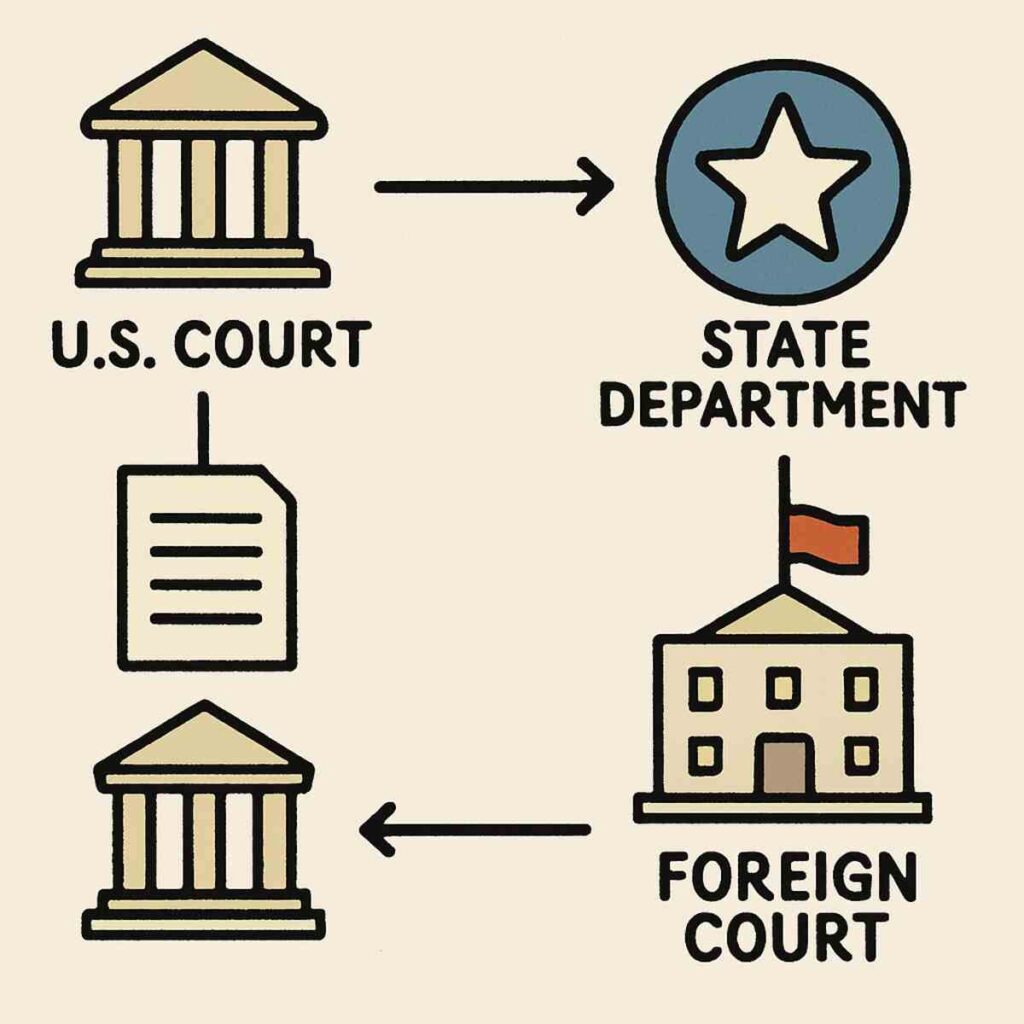
If you need to figure out how to serve a defendant in a foreign country that ignores the Hague Convention, the streamlined rules discussed earlier no longer apply. You cannot simply mail papers or hire a local courier because there is no agreement allowing it. Instead, you face the Letters Rogatory process, a formal request that looks less like a standard lawsuit delivery and more like an international treaty negotiation on a micro-scale.
Unlike the direct “Central Authority” pipeline, this method requires your judge to ask the U.S. Department of State for help, who then transmits the request to the U.S. Embassy in the destination country. The Embassy effectively asks the foreign Ministry of Foreign Affairs for a diplomatic favor to deliver your papers. It is a slow, ceremonial bucket line where your documents pass from one government official to another, often requiring official diplomatic seals at every step to prove validity.
Because your lawsuit is rarely a priority for foreign diplomats, patience is the only option. While a Hague request might take a few months, a Letter Rogatory frequently requires a year or more to complete. The complexity is necessary because without a treaty, you are asking a foreign sovereign nation to enforce U.S. laws within their borders, an act they will only perform if asked through proper, respectful channels.
Success is possible, but this method is unforgiving of errors. Since the paperwork passes through so many hands, clarity is essential, and the foreign court will likely reject anything they cannot read instantly. This leads to the most common stumbling block for both Hague and non-Hague cases: the strict requirement for translating your legal documents.
The Translation Trap: Why One Wrong Word Can Void Your Service
Imagine handing a German judge a stack of English papers; they will likely reject the package immediately, regardless of whether the defendant speaks English. Most international laws, including the Hague Service Convention, allow countries to demand that all legal documents be presented in their official language to protect their citizens’ rights. If you serve a defendant in Tokyo or Mexico City without a proper translation, you aren’t just being impolite—you are failing to meet the strict requirements of that country’s jurisdiction. The result isn’t just a delay; your U.S. judge may eventually rule that the service was invalid because it violated local laws.
Accuracy is critical, so relying on free online tools or a bilingual friend is a recipe for failure. Legal terms like “plaintiff,” “liability,” and “injunction” have specific definitions that do not always have direct equivalents in other languages. You generally need a professional translator who provides a certificate or affidavit confirming the accuracy of the text. To satisfy the strictest foreign courts, you must translate every part of the package:
- The Summons: The official notice commanding the defendant to respond.
- The Complaint: The detailed narrative explaining why you are suing.
- The Exhibits: Any contracts, emails, or photos attached as evidence.
Attempting to cut costs by translating only the “important” pages is a common mistake that often backfires. Foreign Central Authorities frequently view a partial translation as a complete failure to serve, causing them to reject the request after holding it for months. You must present the entire legal argument in a language the local authority recognizes to ensure the process sticks. Once your documents are fully translated and ready for travel, the next challenge is ensuring they reach the correct human being, a task that becomes even trickier when your target is a massive international business.
Serving Foreign Corporations: Finding the Right ‘Agent’ in a Corporate Maze
Walking into a massive office building in London or Paris to hand legal papers to a receptionist rarely works. In the eyes of the law, a corporation is a “legal person,” but it cannot physically grab documents; it designates a specific human or entity—known as a Registered Agent—to accept them on its behalf. If you simply mail your lawsuit to the company’s general headquarters or hand it to a store manager, the court will likely treat it as if you threw the papers in the trash. You must identify the specific officer or agent authorized by local law to receive serving process on foreign corporations to ensure the lawsuit actually “counts.”
A common pitfall involves assuming that a local branch is the same legal entity as the international headquarters. Often, the “Acme Corp” operating in Germany is a legally separate subsidiary from the “Acme Corp” based in the United States, even if they share a logo. Serving the German branch for a dispute involving the American parent company is usually invalid because courts treat them as distinct legal “buckets.” Professional international litigation support services spend significant time verifying corporate structures to ensure you aren’t serving a distant cousin of the company you actually mean to sue.
Successfully navigating this corporate maze requires precision because the goal is to make the service “binding.” This means the corporation is legally forced to acknowledge the lawsuit or face a default judgment. Once you identify the right corporate officer, the process is straightforward, but what happens when you are suing an individual who doesn’t have a public registered office and has actively tried to disappear?
Locating ‘Ghost’ Defendants: Why Google Maps Isn’t Enough for a Judge
Relying on a LinkedIn profile or a Facebook “check-in” to pin down a defendant in another country is often a recipe for failure. While you might be convinced someone is living in a specific apartment in Rome because of their social media posts, a judge requires verified proof of residence, not just a digital footprint. An international process server understands that privacy laws in places like the European Union are much stricter than in the United States, meaning the public records searches you might use at home could be illegal or restricted abroad without proper credentials.
This is where a specialized investigation technique called skip tracing becomes essential for locating evasive individuals. Rather than simply guessing based on internet rumors, professionals utilize credit headers, utility data, and local boots-on-the-ground investigators to confirm a physical address where the defendant actually sleeps. This process turns a “likely location” into a confirmed target, ensuring that when the documents are finally sent out for delivery, they are going to a valid legal address rather than an empty building.
Sometimes, despite the best strategies for overcoming cross-border service challenges, a defendant successfully evades delivery or lives behind a gated fortress that no server can access. In these specific cases, the court may allow “substituted service,” which permits delivering the papers to a responsible co-resident or even publishing a formal notice in a local newspaper. However, a judge will only approve these backup methods if you can prove you exhausted every standard option first.
Whether you locate the individual immediately or have to chase them across borders, the physical act of handing over the papers is only half the battle. Once the delivery—or the attempt—is complete, the server must create a formal legal report detailing exactly how, when, and where the interaction occurred. This document creates the final link in the chain, transforming a successful delivery into the official proof required for your case to proceed.
The Affidavit of Service: Your Golden Ticket Back to Court
Successful delivery means nothing if you cannot prove it to the judge. A simple tracking number or a delivery signature is rarely admissible as evidence in a courtroom because it doesn’t confirm what was inside the envelope or who truly received it. Instead, the court requires a specialized legal document known as an Affidavit of Service. This is a sworn statement signed by the process server, declaring under penalty of perjury that the documents were delivered according to the strict rules of the jurisdiction. Without this document, your lawsuit is essentially paused, no matter how many times the defendant actually touched the papers.
To be accepted by your local judge, a standard affidavit of service for international courts needs to be far more detailed than a simple “mission accomplished” note. The server must meticulously record specific data points to prevent the defendant from later claiming they were never notified. A valid affidavit typically includes:
- Time and Date: The exact moment the interaction occurred.
- Location: The specific address, sometimes including GPS coordinates.
- Person Description: Physical details of the recipient (e.g., gender, approximate age, hair color).
- Method of Service: Whether it was handed directly to the person or left with a co-resident.
- Server Credentials: Proof that the server is legally authorized to perform this task in that country.
When dealing with cross-border cases, validating proof of service overseas often requires an extra authentication step called an Apostille. Think of this as a “passport for your document”—it is an internationally recognized stamp that verifies the signature of the public official (like a notary) on the affidavit is genuine. Countries that are members of the Hague Convention usually demand this specific certification to ensure the document is legitimate before it crosses back into your home court system. Understanding these strict validation layers is crucial, but not every case requires the most expensive, treaty-level route to be effective.
Formal vs. Informal Service: Choosing the Right Strategy for Your Budget
Deciding how to deliver your documents essentially splits into two paths: the official government route or a private alternative. This distinction is often referred to as formal vs informal service methods, and the right choice depends almost entirely on the laws of the country where the defendant lives. While a formal request processed through a government “Central Authority” under the Hague Convention is the gold standard for court acceptance, it is notoriously slow, frequently taking six months or longer to cycle through the foreign bureaucracy.
A faster, private option is often called “informal service,” where you hire a private agent to hand-deliver the papers directly. In countries with relaxed laws, such as the United Kingdom or Canada, this method is perfectly valid and can reduce your wait time from months to mere days. It offers you significantly more control over the specific time and location of the delivery, ensuring the defendant cannot easily dodge the server, and allows you to bypass the backlog of foreign government offices.
Attempting to use a private server in a country that strictly forbids it, however, can act as a fatal error for your lawsuit. Many civil law nations, such as Switzerland or Japan, enforce rigid extraterritorial service of process rules that view private delivery as a violation of their national sovereignty. In these regions, skipping the slow government line renders your service void, forcing you to restart the entire process and pay the fees twice. Even if you choose the correct path, understanding the clock is vital, as neither method happens overnight.
Reality Check: Why International Service Takes Months, Not Days
If you are used to domestic lawsuits where papers are delivered in a few days, the pace of cross-border litigation can be a shock. An international process server often acts more like a project manager than a courier because they are strictly bound by foreign government schedules. Once your request enters a foreign judicial system, it sits in a queue alongside thousands of others, subject to local holidays, strikes, and significant administrative backlog.
While private delivery in places like the UK is fast, formal Hague Service Convention procedures involving a government Central Authority are universally slow. You should advise your legal team to plan around these general benchmarks for government-facilitated service:
- Europe: Typically 3–6 months.
- Asia: Often 6–12 months, with China frequently exceeding a year.
- Latin America: Usually 4–9 months due to complex bureaucratic layers.
Unfortunately, paying extra for “rush” service is rarely an option when dealing with strict government treaties. A judge in Mexico or a clerk in Berlin cannot be hurried to move your file to the top of the stack simply because you are in a rush. Patience is the only strategy for formal service, so it is critical to file your requests early to prevent your case from stalling. Of course, time isn’t the only resource you need to manage; next, you must prepare your wallet for the financial reality.
Budgeting for the Border: Understanding the Real Costs of Global Service
Just as international shipping costs more than a local stamp, cross-border legal document delivery carries a price tag reflecting the complexity of foreign laws. Many litigants get burned by low-cost providers quoting a “flat fee” that turns out to be a mere down payment rather than the final bill. A transparent quote must separate the management fee—what you pay the firm to coordinate logistics—from mandatory government filing fees and vendor disbursements. If a price seems too good to be true, it likely excludes the specific expenses necessary to get your papers past foreign clerks.
Your budget must account for several variables beyond the service fee, with translation often acting as the largest financial hurdle. Many countries under the Hague Service Convention require every page of your complaint and summons to be translated into their official language before a court will accept the file. You are also responsible for paying the foreign Central Authority a processing tax and covering travel costs if a local official must physically drive to a remote address. An international process server helps you forecast these costs so you aren’t blindsided by a bill for translating fifty pages into German or Japanese.
Financial commitment scales dramatically based on the method required by the destination country. While mailing documents is cheap, it carries a high risk of case dismissal, whereas formal diplomatic channels can run into the thousands due to the involvement of multiple government agencies. Because these costs are substantial, you cannot afford to hire an inexperienced provider who might make a mistake that forces you to pay for the entire process twice. Finding a partner who gets it right the first time is essential.
How to Vet an International Process Server: 5 Questions You Must Ask
The internet is flooded with generalists who claim global reach but lack the specialized knowledge to navigate foreign courts. In domestic cases, a mistake might merely cause a delay; in cross-border disputes, improper service can lead to a judge dismissing your lawsuit entirely after months of effort and expense. You need a partner who understands that the rules change the moment you cross a border, rather than someone who simply forwards your documents to a sub-contractor without oversight.
Quality international litigation support services will welcome scrutiny regarding their methods. Before signing a contract, protect your case by asking these five specific questions to gauge a provider’s expertise:
- Specific Experience: “Have you successfully served documents in [Target Country] within the last year?”
- Legal Knowledge: “What is your stance on Hague Convention Article 10 regarding service by mail?” (If they claim mail is always sufficient, be extremely cautious).
- Translation: “Do you coordinate the certified translations required by the foreign Central Authority?”
- Proof: “Will the final affidavit of service meet the specific formatting standards of my local court?”
- Strategy: “What is the contingency plan if the defendant attempts to evade the server?”
Responses to these inquiries will quickly separate true experts from dangerous amateurs. A competent provider, much like a Clarke international process server, will warn you about potential pitfalls in your specific jurisdiction rather than just promising a quick, cheap fix. If a company cannot explain the difference between a formal treaty request and a simple postal dispatch, keep looking. Once you have selected a qualified partner, your focus must shift to gathering the right documents.
Preparing Your ‘Service Packet’: A Checklist for Success
Even the best professional cannot fix a case if the paperwork they are handed is incomplete. When serving legal documents abroad, you are not just sending a complaint; you are assembling a specific “service packet” that must pass through strict bureaucratic checkpoints. This bundle typically requires not only the lawsuit itself but also a summons, specific summary forms mandated by treaties like the Hague Convention, and often, certified translations. A missing page or a photocopy where an original is required can cause a foreign Central Authority—the government agency receiving your request—to reject the entire submission weeks after you sent it.
Details that seem minor in domestic court become deal-breakers internationally. Most foreign jurisdictions strictly require “wet ink” signatures—originals signed by the court clerk in actual pen—rather than digital prints or copies. Furthermore, an international process server will usually ask you to provide duplicate sets of every document. One set serves as the official archive for the foreign government, while the second set is the one actually delivered to the defendant. Failing to provide these exact duplicates often forces authorities to refuse the request, resetting your timeline to zero.
Physical presentation matters just as much as the content within the pages. In many countries, using heavy staples or binding legal papers incorrectly can actually invalidate them if local rules require loose pages for scanning. Your chosen professional should review your packet for these physical nuances before anything leaves your desk, ensuring that your effort isn’t wasted on a formatting technicality. With a perfectly compliant packet in transit, the waiting game begins, requiring you to understand exactly how the delivery phase unfolds.
What Happens After the Service? Your 5-Step Action Plan
You started this process wondering how to bridge the gap between your local court and a defendant halfway across the world. What initially looked like a bureaucratic maze of treaties and translation requirements is now a navigable path. By choosing to use a professional international process server, you have traded uncertainty for the security of knowing your lawsuit rests on solid ground.
Once the documents have been successfully delivered, your role shifts from managing logistics back to legal strategy. Receiving the official proof isn’t just the end of the delivery phase; it is the green light for your actual arguments to begin.
To ensure cross-border legal document delivery translates into a valid lawsuit, follow this final checklist:
- Review the Affidavit: Check the proof of service for accuracy regarding dates, names, and the specific method used.
- File with the Court: Submit the original documents to your local clerk immediately to establish the timeline.
- Notify Your Team: Inform your attorney that service is complete so they can trigger the next legal steps.
- Monitor Deadlines: Track the specific response time allowed by the foreign jurisdiction.
- Prepare for Litigation: Shift your focus from “how to serve” to “how to win.”
Validating proof of service overseas effectively closes the door on procedural challenges and opens the floor for justice. You are no longer just trying to get the defendant’s attention; you are officially holding them accountable. With the technical hurdles cleared, you can confidently turn your focus to the merits of your case and the outcome you deserve.
